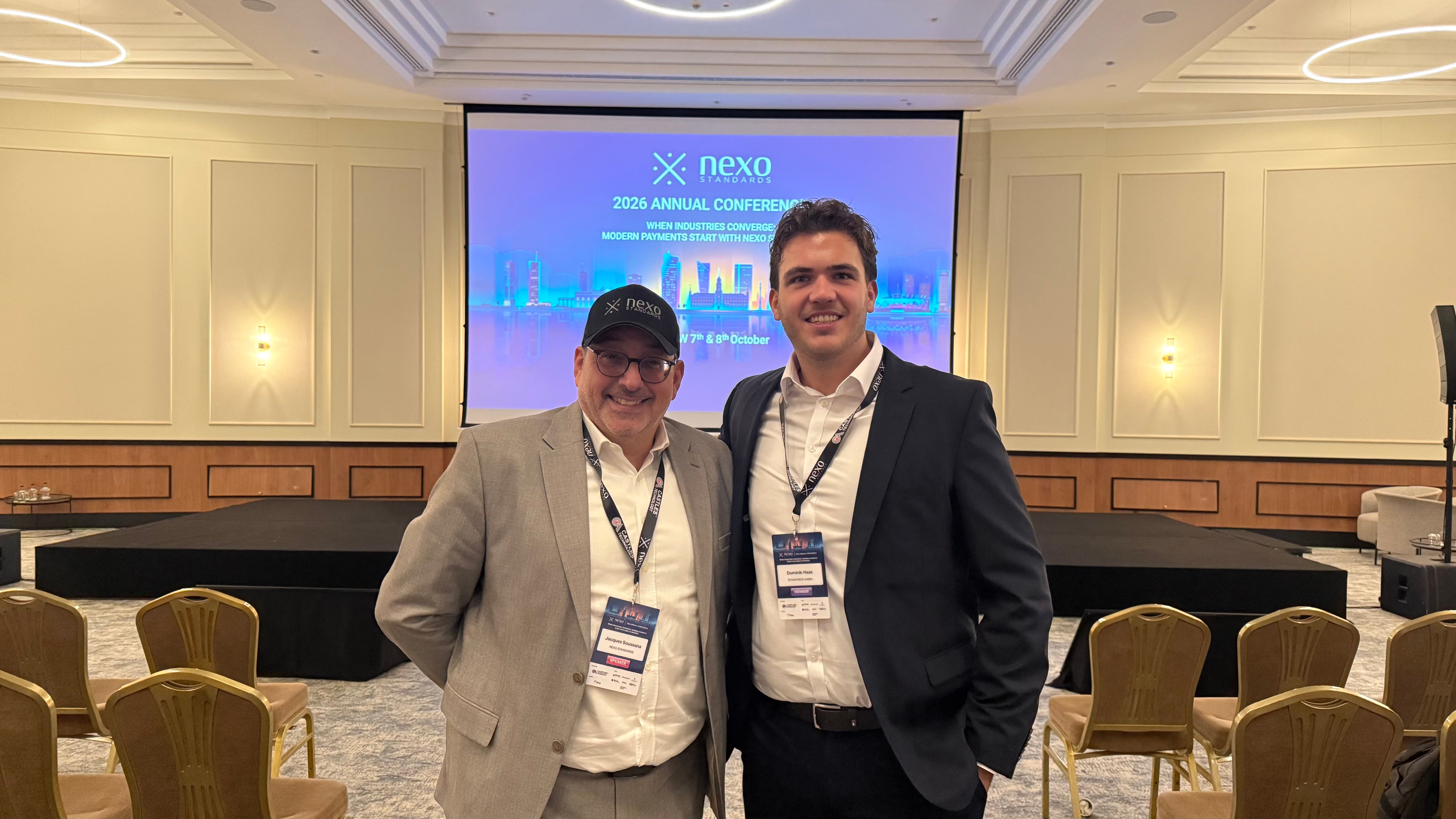
Two days, one topic that ran through nearly every session: How can we transform many national payment systems into an interconnected European payment system? Our colleague Dominik Haas attended the nexo Standards Annual Conference 2026 in Warsaw on October 7 and 8 and has summarized the most important developments for us.
The conference brought together banks, payment service providers, acquirers, payment schemes, manufacturers, and technology providers. The focus was on open standards, interoperability, and the question of how the European payments landscape will evolve in the coming years. For Dominik Haas, Manager of Banking Solutions at synaforce, this was a great opportunity to discuss current trends directly with the people who are shaping them.
For us, nexo is not just a topic we observe from the outside: As an active member, synaforce has helped develop the new protocol from the very beginning. We therefore know exactly which practical requirements are incorporated into the standards and what their further development means for the operation of payment and ATM (Automated Teller Machine) infrastructures.
Interoperability is becoming a key success factor
National payment systems such as BLIK are increasingly geared toward Europe-wide interconnectivity. Discussions surrounding the European Payments Alliance (EuroPA), Wero as the payment solution of the European Payments Initiative (EPI), and the European Network for Payments (ENP) have shown just how strong the demand is for cross-border, interoperable payment solutions.
Open standards are considered key in this regard: They reduce the complexity of integrations and make it easier to connect systems from different providers.
APIs Instead of Individual Integrations
D
nexo has a clear strategy: moving away from standards based on Extensible Markup Language (XML) toward modern frameworks for application programming interfaces (APIs). The focus is on standardized integrations via REST (Representational State Transfer) interfaces and the JSON (JavaScript Object Notation) data format.
In addition, nexo is establishing a certification framework. This is intended to ensure that interoperability and compliance can be verifiably demonstrated in the future, rather than existing only on paper.
The Digital Euro and New Payment Methods Are on the Horizon
The Digital Euro and the requirements for central bank digital currencies (CBDCs) are an integral part of nexo’s roadmap. The goal is to prepare trading and acceptance systems for these developments at an early stage. Initial pilot activities are already being prepared.
Payments, Identity, and AI Are Converging
Future commerce platforms will be built not only on payments, but also on digital identities and agents based on artificial intelligence (AI). Scenarios were discussed in which AI agents autonomously execute purchase and payment processes within defined rules.
For this to work, two things are needed: trustworthy digital identities and standardized data models.
Particularly Exciting: BLIK as a European Success Story
A highlight was the look at BLIK. The Polish system now processes billions of transactions per year and ranks among Europe’s largest mobile payment systems. BLIK demonstrates how mobile banking, instant payments, and account-to-account (A2A) payments can be successfully combined.
For its next phase of growth, BLIK has emphasized interoperability as a key prerequisite. This is based on cross-platform communication as well as a secure and high-performance hosting solution through which transactions are processed.
What this means for synaforce
The conference topics confirm how important open standards are for modern payment and ATM infrastructures. As a founding member of nexo, we see this as validation of our approach: what we helped build is now evolving into the foundation for a connected European payment system. Of particular relevance to us are:
- API standards that simplify integrations and make them comparable
- A2A payments as a growing alternative to traditional card payments
- The Digital Euro as a new requirement for merchant and acceptance systems
- European interoperability as the foundation for cross-border solutions
For synaforce, these are key building blocks for the secure, future-proof, and cloud-ready operation of self-service and payment platforms. The example of BLIK shows that new payment methods require an infrastructure that is secure, high-performing, and highly available.
Our Conclusion
The nexo Standards Annual Conference 2026 made it clear: The future of payments will be shaped by interoperability, open APIs, digital identities, real-time payments, and AI. We are actively tracking these developments to support our customers in designing modern, secure, and cloud-ready payment and ATM infrastructures.
#synaforce#banking #nexo #DigitalEuro